When Malaysians think about semiconductor investing, they think:
Nvidia.
TSMC.
US tech ETFs.
Almost nobody looks at what’s happening at home.
But here’s the structural truth:
Malaysia is one of the world’s largest players in semiconductor assembly, testing, and packaging. We don’t design the chips. We finish them. And that finishing layer is critical.
1. Why Malaysia Matters in the Chip Industry
Malaysia is heavily involved in:
- Semiconductor assembly & testing
- Backend manufacturing
- Packaging
- Industrial electronics support
Penang, Kulim, and parts of Johor have become semiconductor clusters.
Major global players operate here.
This isn’t speculation.
It’s structural supply chain positioning.
When global chip demand rises, Malaysia participates.
2. The Retail Access Angle (What You Can Actually Invest In)
This is not private equity.
Retail investors can access exposure via:
Malaysian Semiconductor Stocks
Examples include:
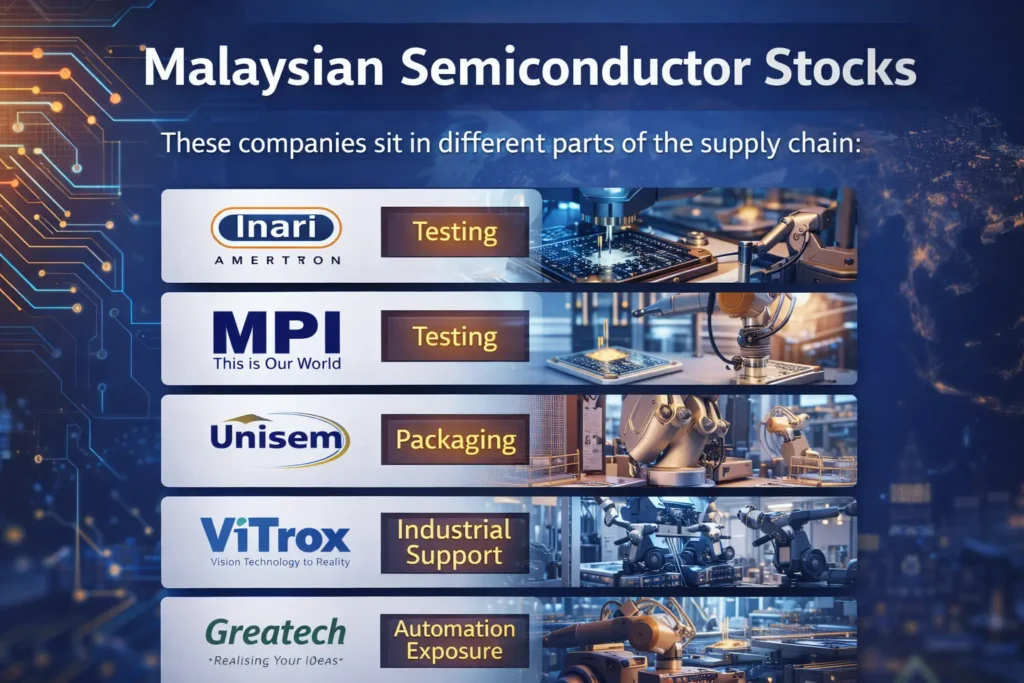
- Inari Amertron
- MPI
- Unisem
- Vitrox
- Greatech (automation exposure)
These companies sit in different parts of the supply chain.
Some focus on testing. Some on automation. Some on industrial support.
This gives you options.
ETF Exposure
Instead of stock-picking:
- Global semiconductor ETFs
- Technology-heavy index funds
- Malaysia-focused ETFs (if sector weight allows)
This spreads risk.
Industrial & Support Companies
Beyond chip companies:
- Industrial automation firms
- Precision engineering suppliers
- Logistics providers linked to export flows
Sometimes the “support layer” earns steady returns while chip headlines dominate.
3. Why 2026 Is Interesting
Three structural drivers:
AI & Data Centre Demand
AI chips drive backend demand.
US–China Tensions
Supply chain diversification benefits ASEAN.
Malaysia’s Incentive Programs
Government support for high-value manufacturing.
This isn’t short-term speculation. It’s geopolitical restructuring.
4. The Risk You Must Understand
Semiconductors are cyclical.
When demand drops:
- Earnings compress
- Valuations fall
- Sentiment turns quickly
Chip stocks are volatile. This is not a defensive income play.
It’s a growth theme with cycles.
5. Who This Is Suitable For
This theme fits investors who:
- Already have core stable holdings
- Understand volatility
- Can hold through cycles
- Want structural growth exposure
It is not ideal for:
- Emergency fund allocation
- Low-risk retirees
- Short-term traders chasing headlines
6. A Simple Allocation Strategy
Instead of betting everything on one stock:
Example allocation:
- 10–20% portfolio to semiconductor exposure
- Blend of 1–2 Malaysian names + global ETF
- Rebalance annually
Treat it as a structural growth sleeve.
Not your entire strategy.
Final Thoughts
Everyone wants to own the chip designer.
Few look at the supply chain finishing the chips. Malaysia sits in that layer.
Not glamorous. Not headline-dominating. But structurally important.
In 2026, the semiconductor story may not just be American.
It may quietly include Penang and Kulim.
Read More
If you’re exploring alternative investment themes beyond traditional stocks, these guides will help you diversify smarter:
Why P2P Financing Is the High-Return Investment Malaysians Miss
Learn how regulated peer-to-peer financing platforms can generate 8–16% annual returns — and what risks you must understand before investing.
Industrial REIT: The Ultimate 6% Dividend Strategy Revealed
Discover how industrial REITs provide steady dividend income from warehouses and logistics assets — without becoming a landlord.