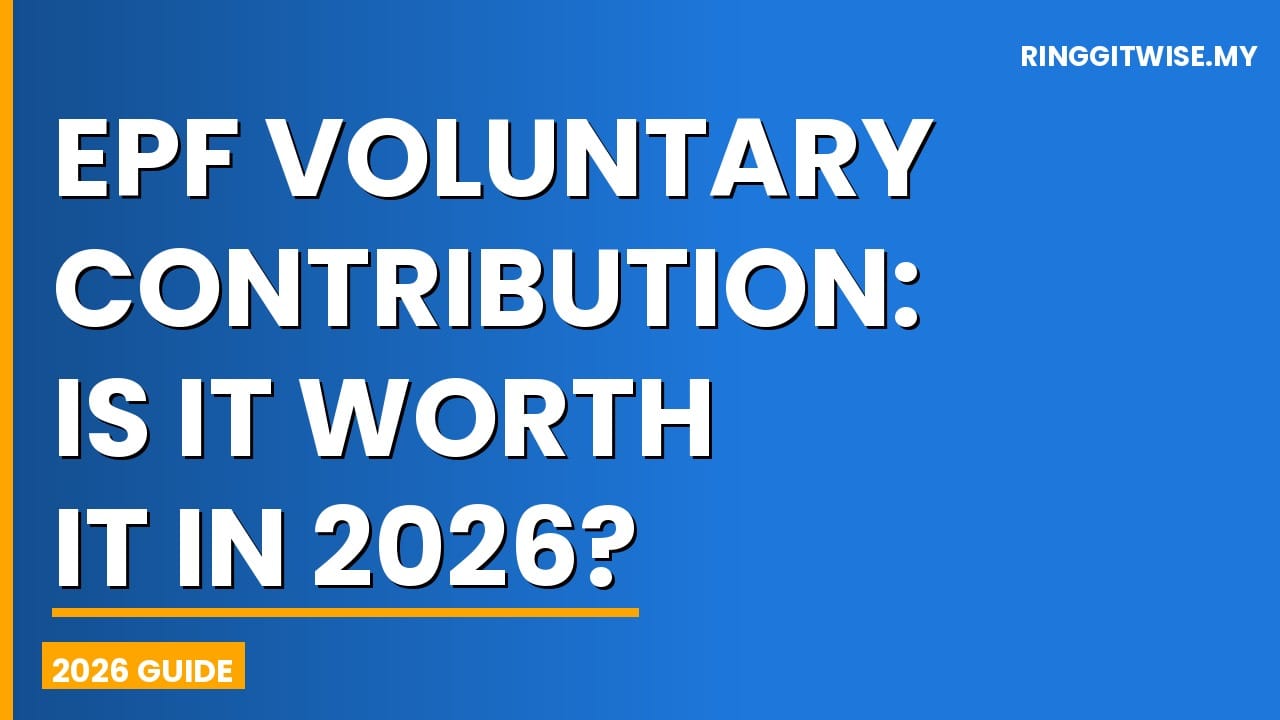
Most Malaysians treat EPF as something that just happens to their salary. But voluntary contribution is a choice. And in 2026, it might be one of the smartest financial moves you can make.
This article is for salaried workers, freelancers, and business owners who want to know if topping up EPF actually pays off. Spoiler: the numbers are more compelling than you think.
Table of Contents
- 1. What Is EPF Voluntary Contribution?
- 2. Who Can Make Voluntary Contributions?
- 3. The Dividend Returns: What EPF Actually Pays You
- 4. The Tax Relief Angle You Cannot Ignore
- 5. How EPF Stacks Up Against FD, ASB, and Unit Trusts
- 6. The Real Downsides of Locking Your Money in EPF
- 7. Who Should Actually Do This in 2026?
- 8. How to Make Your Voluntary Contribution
- Final Thoughts
- Read More
1. What Is EPF Voluntary Contribution?
Beyond your standard monthly deduction, EPF allows you to put in extra money on your own terms. This is called voluntary contribution or caruman sukarela in Bahasa Malaysia.
You are not locked into a fixed schedule. You can contribute any amount, at any time, as long as you do not exceed the annual limit. The money goes into your EPF account and earns the same dividend as your regular savings.
Think of it as a savings account that beats most banks, comes with government backing, and gives you a tax break on top.
2. Who Can Make Voluntary Contributions?
This is where many Malaysians get it wrong. Voluntary contributions are not just for salaried employees.
- Salaried employees who want to top up beyond their mandatory 11% deduction
- Freelancers and gig workers with no employer EPF contribution at all
- Business owners who pay themselves without a payroll structure
- Housewives and homemakers who want to build their own retirement fund
- Non-Malaysians with a valid Malaysian identity card or work permit
If you have a Malaysian IC or a valid EPF account, you can contribute voluntarily. The annual cap for voluntary contribution is RM100,000 per year.
3. The Dividend Returns: What EPF Actually Pays You
EPF declared a 6.30% dividend for conventional savings and 5.85% for shariah savings for 2024. In 2026, expectations remain in the 5.5% to 6.5% range based on historical trends.
Let that sink in. A fixed deposit at Maybank or CIMB right now gives you roughly 3.0% to 3.8% per year. EPF has consistently delivered more, with zero credit risk because it is guaranteed by the Malaysian government.
On a RM20,000 voluntary top-up, a 6% dividend means RM1,200 added to your account in one year. No stock picking. No market timing. Just leave it there.
4. The Tax Relief Angle You Cannot Ignore
Here is where voluntary contribution becomes a genuine tax strategy. EPF contributions qualify for personal tax relief of up to RM4,000 per year under the EPF and life insurance combined relief category.
If your mandatory EPF deduction has not used up the full RM4,000, a voluntary top-up fills that gap. If you are in the 24% tax bracket, every RM1,000 of eligible contribution saves you RM240 in actual tax.
Combine the 6% dividend plus the tax savings, and your effective return can easily hit 8% to 10% in the first year. No unit trust fund in Malaysia regularly beats that on a risk-adjusted basis.
5. How EPF Stacks Up Against FD, ASB, and Unit Trusts
Let us put it side by side so you can see clearly.
- Fixed Deposit (Maybank, Public Bank): 3.0% to 3.8% per year, fully liquid, no tax relief
- ASB (Amanah Saham Bumiputera): roughly 4.5% to 5.5%, limited to Bumiputera, capped at RM200,000
- Unit Trusts (Public Mutual, Kenanga): variable returns, can lose money, management fees eat into gains
- EPF Voluntary: 5.5% to 6.5% historically, government guaranteed, tax relief eligible, no fees
For low-risk, guaranteed returns with a tax benefit attached, EPF is hard to beat in 2026. The only serious competitor for Bumiputera investors is ASB, and even then EPF wins on flexibility and higher caps.
6. The Real Downsides of Locking Your Money in EPF
Nothing is perfect. You need to know the risks before you commit.
- Your money is locked until age 55 as a general rule, with limited early withdrawal options
- Partial withdrawals are allowed for housing, education, and medical but come with conditions and delays
- Dividends are not guaranteed year to year, though EPF has never declared below 5% since 2011
- No access in emergencies unless you qualify for specific withdrawal categories
- Inflation risk over very long periods if dividends drop, though historically EPF has kept pace
The illiquidity is the biggest concern. Do not put your emergency fund here. Keep three to six months of expenses in a liquid savings account first.
7. Who Should Actually Do This in 2026?
Voluntary contribution is not for everyone in every situation. Here is the honest breakdown.
Strong candidates for voluntary top-up
- You have an emergency fund already set aside
- You are in the 19% to 30% income tax bracket
- You are a freelancer or self-employed with no employer contribution
- You are aged 35 to 50 and your EPF balance is below the recommended savings target
- You want a guaranteed return without stock market exposure
Think twice if
- You have high-interest debt like credit card balances above 15%
- You do not yet have three months of emergency savings
- You are under 30 with high risk tolerance and a long investment horizon
- You expect to need the cash within five years
8. How to Make Your Voluntary Contribution
EPF has made this genuinely easy in 2026. Here are your options.
- i-Akaun app: log in and use the voluntary contribution feature directly
- EPF website: accessible at kwsp.gov.my with full transaction support
- JomPAY: use biller code 700003, pay through any Malaysian banking app
- EPF counters: walk in with your IC and cash or cheque if you prefer
- Minimum contribution: as low as RM10 per transaction
The contribution is usually reflected in your account within two to three working days. Make sure you contribute before 31 December to qualify for that year’s tax relief.
Final Thoughts
EPF voluntary contribution in 2026 is not a gimmick. It is a government-backed, tax-efficient way to grow your retirement savings at a rate most unit trusts struggle to match consistently.
Sort out your emergency fund and clear high-interest debt first. Then treat EPF top-ups as your boring-but-brilliant foundation layer.
Your 60-year-old self will not care that it was unexciting. They will care that the money is there.
Read More
How to Use EPF Like a High-Return Bond (2026)
A deeper strategy for using EPF as the fixed-income backbone of your entire portfolio.
Most Malaysians Will Retire Broke
The hard truth about retirement readiness in Malaysia and exactly what to do about it now.