Most Malaysians think solar panels are for rich people or eco-warriors.
They are not.
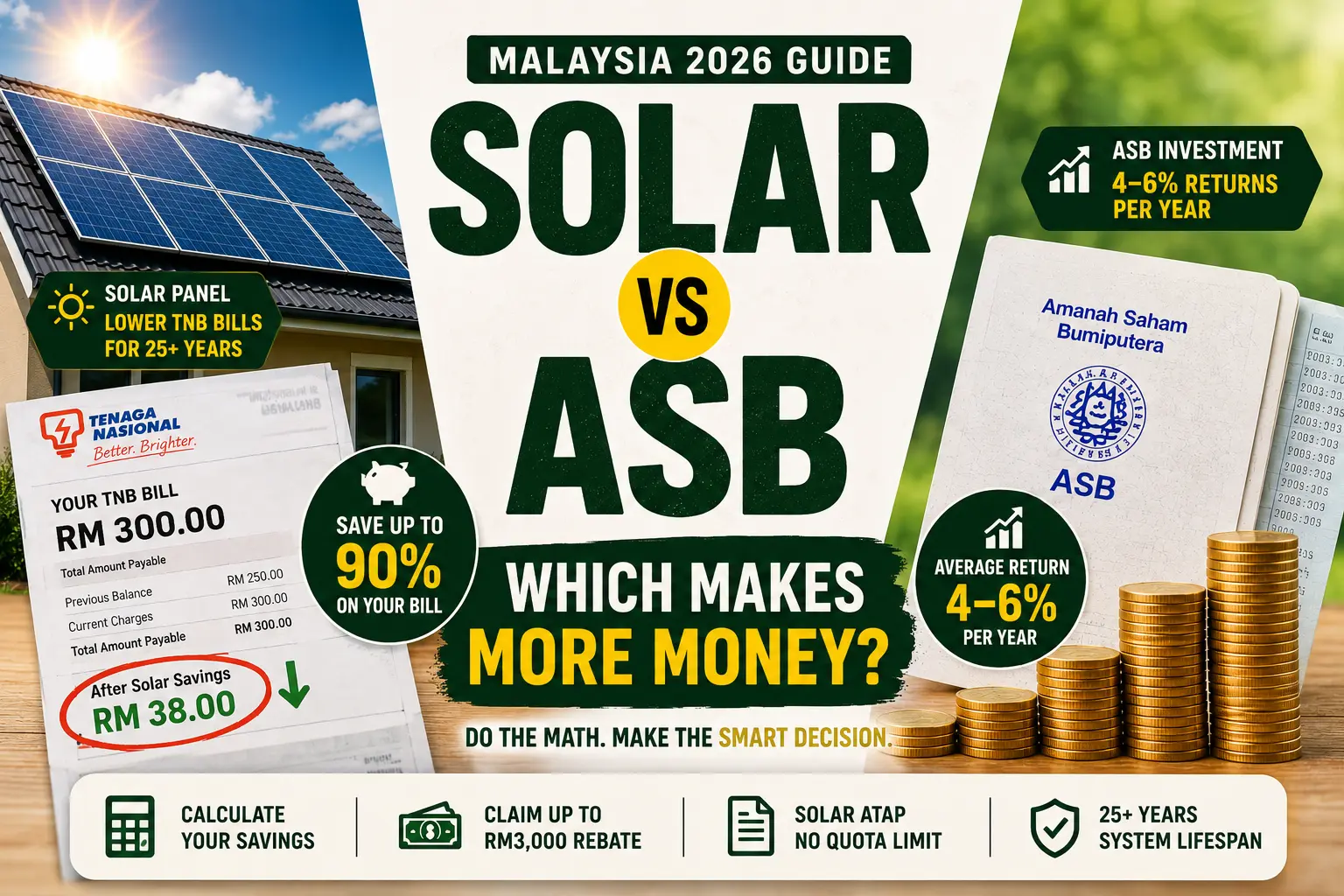
A solar system on your roof is a financial decision. A big one. And in 2026, with TNB tariffs rising, the government handing out up to RM3,000 cash back, and a brand new no-quota scheme called Solar ATAP, the numbers finally make sense for ordinary Malaysian homeowners.
But does it make sense for you? That depends entirely on your TNB bill, your property, and how long you plan to stay. We ran the maths. Here is the honest answer.
Table of Contents
- 1. What Changed in 2026: Solar ATAP and the SuRIA Rebate
- 2. How Solar Actually Saves You Money in Malaysia
- 3. Who It Works For (And Who It Does Not)
- 4. The Real Numbers: What a RM300 Bill Homeowner Can Expect
- 5. Solar Savings Calculator: Is It Worth It For You?
- 6. SuRIA Home Rebate: How to Claim Your RM3,000
- 7. Solar vs ASB vs EPF: The Honest Comparison
- 8. How to Get Started: Step by Step
- Final Thoughts
- Read More
1. What Changed in 2026: Solar ATAP and the SuRIA Rebate
Two things happened in 2026 that make solar worth taking seriously again.
Solar ATAP replaced NEM 3.0 on 1 January 2026. The old Net Energy Metering (NEM) scheme had a national quota that kept filling up and leaving people on waitlists. Solar ATAP has no quota limit. Anyone can apply, any time, starting from January 2026. You install, you self-consume your solar electricity first, and you export whatever is left back to TNB for a bill credit.
SuRIA Home launched on 1 June 2026. PETRA (the Ministry of Energy Transition and Water Transformation) introduced a direct cash rebate: RM600 per kWac of installed capacity, up to a maximum of RM3,000. This is the first time the government has given homeowners actual cash back for rooftop solar since the Feed-in Tariff era ended. The quota is 250MW nationwide and it is first-come-first-served.
Put both together and the maths for a landed homeowner shifts significantly. A system that cost RM19,000 before now costs RM16,000 after the rebate. That alone cuts 1 to 2 years off the payback period.
2. How Solar Actually Saves You Money in Malaysia
Solar saves you money in two ways under Solar ATAP.
Self-consumption. Whatever solar electricity you use directly during the day, you do not buy from TNB. If your system generates 20 kWh on a Tuesday and you use 15 kWh of it (aircond, fridge, washing machine), TNB only bills you for the remaining 5 kWh plus whatever you use at night.
Export bill credit. Any electricity your system generates that you do not use gets exported to the TNB grid. Under Solar ATAP, TNB credits your account at the retail rate: RM0.27/kWh if your monthly bill is below RM300, or RM0.37/kWh if it is above. This credit offsets your next bill. It is not a cash payment. It reduces what you owe.
The key insight most people miss: how much you save depends heavily on how much electricity you use during the day. A work-from-home household with aircond running from 9am to 5pm can self-consume 65 to 70% of what their system generates. An office worker who leaves home at 8am and returns at 7pm might only self-consume 25 to 35%. Same system, completely different savings.
3. Who It Works For (And Who It Does Not)
Solar is not for everyone. Here is the honest breakdown.
It works well if you:
- Own a landed property (terrace, semi-D, bungalow) with a south or west-facing roof
- Have a monthly TNB bill above RM200
- Plan to stay in the property for at least 8 to 10 years
- Have some daytime electricity usage (aircond, water heater, EV charging)
- Want lower monthly bills from day one regardless of long-term ROI
It does not make sense if you:
- Live in an apartment or condo (Solar ATAP requires individual roof ownership)
- Are renting (you cannot install on someone else’s property)
- Plan to sell or move within 5 years
- Have a monthly TNB bill below RM150 (system too large relative to usage)
- Own an investment property where the tenant pays the electricity bill
If you own an investment property and you are paying for the electricity, that is a different calculation. But if your tenant pays their own bills, spending RM17,000 on solar reduces the tenant’s bill, not yours. That money works harder elsewhere.
4. The Real Numbers: What a RM300 Bill Homeowner Can Expect
Let us use a realistic example. Semi-D in Selangor. Monthly TNB bill RM300. Works from home three days a week. Plans to stay 15 years.
- Recommended system size: 5 to 6 kWp
- Gross installation cost: approximately RM22,000
- SuRIA Home rebate: RM3,000 (capped at maximum)
- Net cost after rebate: approximately RM19,000
- Monthly TNB bill saving: RM180 to RM260 depending on daytime usage
- Payback period: 7 to 10 years
- Net profit over 15 years: RM20,000 to RM35,000 after inverter replacement cost
Those numbers assume conservative 1.5% annual TNB tariff inflation and 0.5% annual panel degradation. They also include an inverter replacement at year 12 costing roughly RM5,000.
One important note: the same RM19,000 in ASB at 5.5% compounded over 15 years grows to approximately RM44,000 in final value. Solar typically does not beat compounded financial returns in pure mathematical terms. What it does do is give you immediate monthly cash flow relief, protect you against future TNB tariff increases, and add tangible value to your property.
5. Solar Savings Calculator: Is It Worth It For You?
Stop guessing. Enter your actual details below and get a personalised answer in 30 seconds. This calculator uses real Solar ATAP export rates, occupancy-adjusted self-consumption, inverter replacement costs, and the SuRIA Home rebate. It also compares your result against ASB returns so you can make an honest decision.
Solar panels in Malaysia: is it actually worth it?
Enter your TNB bill and roof details. Get an honest, unbiased answer in 30 seconds. No sales pitch. Just real numbers.
| Item | Amount |
|---|
| Programme | What you get | Status |
|---|---|---|
| Solar ATAP SEDA Malaysia | Self-consume solar first, export excess to TNB at RM0.27-0.37/kWh as bill credit. No quota limit. 10-year contract. | Open Jan 2026 |
| SuRIA Home PETRA | Cash rebate RM600/kWac, max RM3,000. Processed after TNB commissioning. First-come-first-served on 250MW quota. | Open Jun 2026 |
| SolaRIS SEDA | Previous scheme: RM1,000/kWac up to RM4,000 for NEM Rakyat customers. Check if you are still eligible. | Check eligibility |
| Sarawak NEM Sarawak Energy | Up to RM12,000 subsidy for Sarawak domestic customers only under Sarawak Energy NEM. | Sarawak only |
6. SuRIA Home Rebate: How to Claim Your RM3,000
The SuRIA Home rebate does not require a separate application. Here is how the process works from start to rebate-in-hand.
- Step 1: Engage a SEDA-registered solar installer. They handle the Solar ATAP application to SEDA on your behalf.
- Step 2: SEDA approves the application. This typically takes 2 to 3 weeks.
- Step 3: TNB processes the grid connection after SEDA approval. Another 2 to 4 weeks.
- Step 4: Installation and commissioning. Your system goes live.
- Step 5: SuRIA Home rebate is processed automatically after TNB commissioning. Disbursement timeline is 8 to 12 weeks from commissioning.
Total timeline from first enquiry to rebate received: realistically 3 to 4 months. The quota is 250MW nationally. Once it fills, the rebate ends. There is no published tracker for remaining quota so the only way to secure it is to move now.
One thing to verify: the rebate is RM600 per kWac, not kWp. A 5 kWp system with a 5 kWac inverter gets RM3,000 (capped). A 4 kWp system at 3.7 kWac gets RM2,220. Always confirm the kWac rating with your installer before signing.
7. Solar vs ASB vs EPF: The Honest Comparison
This is the question most solar companies will never answer honestly. We will.
| Option | RM19,000 invested for 15 years | Liquidity | Inflation hedge |
|---|---|---|---|
| Solar | RM20k to RM35k net profit (estimate) | None (fixed asset) | Yes, strongly |
| ASB | RM25k to RM30k net profit at 5.5% | High | Partial |
| EPF voluntary | RM27k to RM32k net profit at 5.5 to 6% | Very low | Partial |
| Fixed Deposit | RM10k to RM14k net profit at 3.5% | Medium | No |
The honest conclusion: ASB and EPF voluntary contributions likely generate higher pure financial returns than solar over 15 to 25 years. Solar wins on three things that financial products cannot give you: immediate monthly cash flow (your bill drops from day one), a physical hedge against future TNB tariff increases, and a tangible improvement to your property value.
The smartest answer is not either/or. If you have RM19,000 sitting in a savings account earning 2%, solar is better. If you have nothing in ASB or EPF voluntary yet, fill those first. If you already have strong savings and investments and you own a landed home with a RM250 or above monthly TNB bill, solar is a very rational next move.
8. How to Get Started: Step by Step
If the calculator above showed a positive result for your situation, here is how to move forward without getting ripped off.
- Only deal with SEDA-registered installers. Check the SEDA Malaysia website (seda.gov.my) to verify. Unregistered installers cannot file the Solar ATAP application on your behalf and you will not be eligible for the SuRIA rebate.
- Get at least 3 quotes. Prices in 2026 range from RM3,800 to RM4,500 per kWp installed. Anyone quoting above RM5,000/kWp or below RM3,500/kWp without a clear explanation deserves scrutiny.
- Ask specifically about kWac, not just kWp. The SuRIA rebate is calculated on kWac. A good installer will give you both numbers upfront.
- Check the inverter brand and warranty. Panels last 25 years. Inverters typically last 10 to 15 years. The inverter brand matters as much as the panel brand. Huawei, SMA, Fronius, and Solis are well-supported in Malaysia.
- Read the Solar ATAP contract duration. It is a 10-year contract with TNB. Understand what happens if you sell the property within that period.
Use the quote request form in the calculator above to get connected with verified installers. We only work with SEDA-registered companies.
Final Thoughts
Solar in Malaysia has finally reached a point where the numbers work for the average landed homeowner.
Not because it is glamorous. Not because of climate commitments. Because RM300 TNB bills are painful, tariffs are not going down, and a well-sized system can cut that bill by half from the month it goes live.
The SuRIA Home rebate makes 2026 the best time to install in years. That quota will not last forever.
Run your numbers in the calculator above. If the result says yes, get three quotes. If it says no, invest that money in ASB instead. Either way, now you know.
Read More
How to Use EPF Like a High-Return Bond (2026 Strategy)
If solar does not make sense for your situation, here is how to put that same capital to work inside EPF for stable, government-backed compounding.
The Truth About Financial Freedom in Malaysia
Solar, EPF, ASB. They are all tools. This guide puts them in context of what financial freedom actually looks like for a Malaysian household in 2026.